
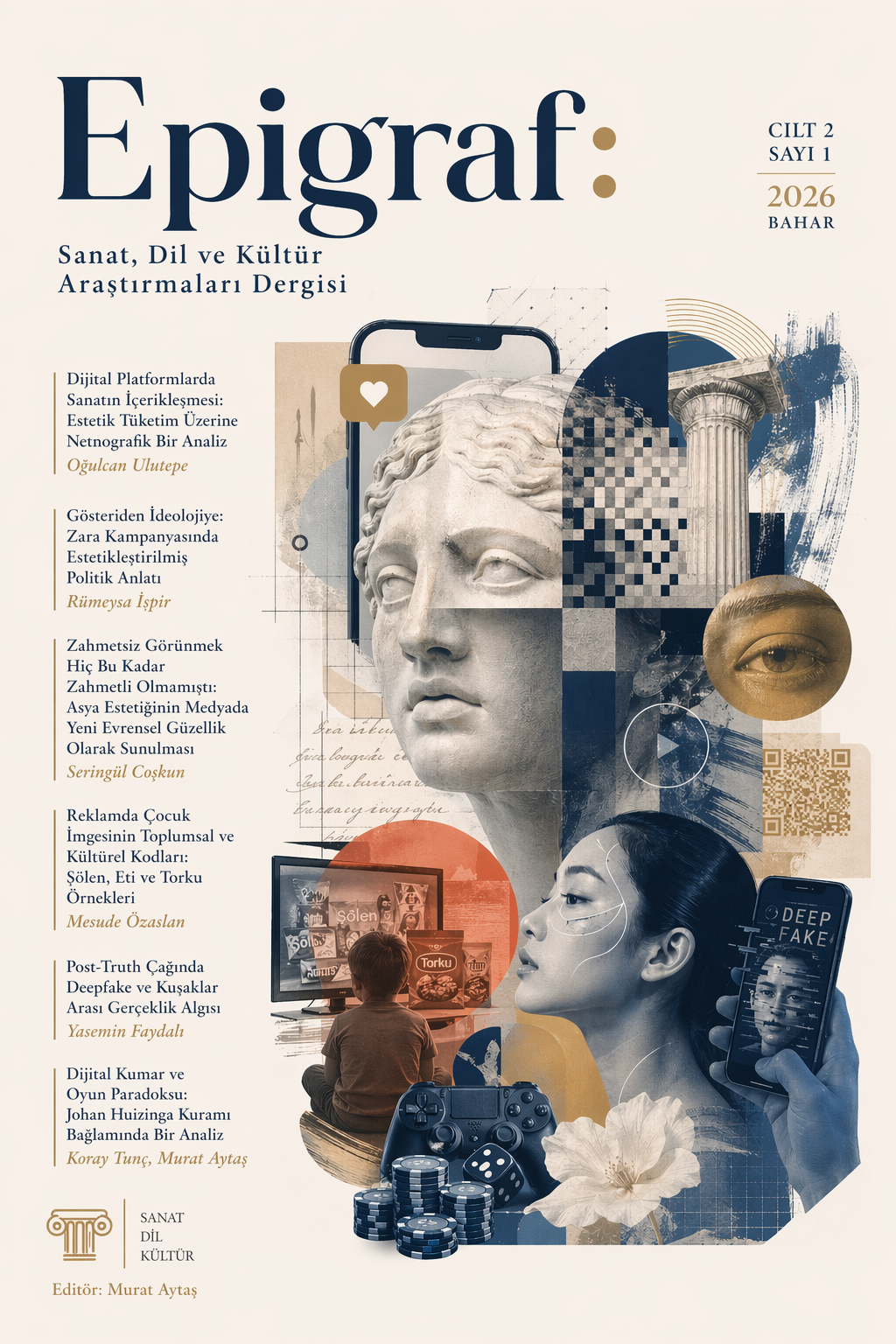
Deepfake and Intergenerational Perception of Reality in the Post-Truth Era
Article Sidebar
Main Article Content
Abstract
This study aims to analyze, through an analytical lens, the psychological repercussions and the erosion of reality perception caused by AI-based deepfake technology among Generation X and Generation Z in Turkey, within the context of the post-truth climate. In today's information ecosystem, where objective reality is relegated to a secondary position to individual judgments and emotional reflexes, deepfakes exploit the ancient human tendency to accept visual data as absolute truth. Consequently, it leads to epistemological anxiety, erosion of trust, and cognitive exhaustion. Within the scope of the research, moving from Marc Prensky’s conceptualizations of "Digital Natives" and "Digital Immigrants," a quantitative survey was conducted with a total of 40 participants, comprising 20 individuals from Generation X and 20 from Generation Z residing in the provinces of Istanbul, Konya, and Adana. The empirical data obtained proves the existence of a structural cognitive gap between the two generations. 100% of the Generation Z participants flawlessly identified the presented synthetic content based on visual imbalances and digital imperfections. For this generation, digital trust is not a default right but a transient conviction attained through continuous verification. In contrast, among Generation X, only 35% of participants correctly diagnosed the content in the initial stage, while 65% characterized the video as real. When deciphering digital manipulations, Generation X focuses on contextual and logical inconsistencies rather than technical details. During this process, the power of education was demonstrated through a short-term technical briefing intervention conducted with Generation X; this resulted in 61.5% of the participants who initially erred revising their flawed inferences. This underscores the significant impact of pedagogical support in narrowing the gap between digital immigrants and the complexities of synthetic media. Generation Z. The findings underscore the urgency of digital literacy strategies and legal regulations tailored to the distinct needs of each generation in the fight against disinformation.
Article Details

This work is licensed under a Creative Commons Attribution 4.0 International License.
References
Aydemir, M. (2025). Sosyal bilimlerde yapay zekâ çalışmalarına yönelik kapsam taraması: DergiPark veritabanı örneği. Sosyal Bilimler Enstitüsü Dergisi, 56, 327–347. https://doi.org/10.52642/susbed.1623364
Aytaş, M., & Parsa, A. (2014). Yeni gerçeklik: Dijital yerliler ve göçmenlerle 21. yüzyıl okuryazarlığında birleşmek. In Z. B. Akıncı Vural (Ed.), Dijital panorama: Bilgi iletişim teknolojilerinde son gündem.
Aytaş, M. (2024). Ağ Toplumu ve Dijital Medyada Ontoloji, Zaman/Mekân Kavramlarını Yeniden Okumak. The Journal Of Academic Social Science, 37(37), 399-409.
Belen, N., & Yalçın, N. (2025). Deepfake teknolojisi ve ceza hukuku: Ses ve görüntü manipülasyonlarından doğan cezai sorumluluk. International Strategic Research Journal, 10(2), 202–228. https://doi.org/10.23834/isrjournal.1620843
Çiçek, H. K., & Yalçın, N. (2024). Is deepfake a threat or an opportunity? EuroAsia Journal of Applied Sciences, 11, 32.
Demircan, B. (2021). Gördüğün her şeye inanma: Derin sahte çalışmaları üzerine bir doküman analizi. İletişim, 6(13).
Goodfellow, I. J., Pouget-Abadie, J., Mirza, M., Xu, B., Warde-Farley, D., Ozair, S., Courville, A., & Bengio, Y. (2014). Generative adversarial nets. Advances in Neural Information Processing Systems, 27, 2672–2680.
Gupta, R., Jain, R., Khandelwal, S., & Agrawal, A. (2022). Deepfake generation and detection: State-of-the-art, taxonomy, and future directions. Artificial Intelligence Review.
Güneş, A. (2025). Deepfake’in elektronik ortamda yapay zekâ tabanlı kimlik doğrulama sürecine etkisi. Bilgi Teknolojileri ve İletişim Dergisi (BTK Dergi), 3(1).
Harris, D. A. (2019). Deepfakes: False pornography is here and the law cannot protect you. Duke Law & Technology Review, 17(1), 99–127.
Keyes, R. (2004). The post-truth era: Dishonesty and deception in contemporary life. Delidolu Yayıncılık.
Mumcu, B. (2024). Deepfake: Gerçeklik algısını temelden sarsan teknoloji. https://api.batuhanmumcu.com.tr/uploads/publication/ekler/deepfake-makale.pdf
Pennycook, G., & Rand, D. G. (2021). The psychology of fake news. Trends in Cognitive Sciences, 25(5). https://www.cell.com/trends/cognitive-sciences/fulltext/S1364-6613(21)00051-6
Prensky, M. (2001). Digital natives, digital immigrants. On the Horizon. MCB University Press.
Rini, R. (2017). The problem of false belief in the public sphere. The Philosopher’s Magazine, 79, 24–30.
Rubin, V. L. (2019). Disinformation and misinformation triangle: A conceptual model for fake news epidemic, causal factors and interventions. Journal of Documentation, 75(5), 1013–1034.
Schick, N. (2020). Deepfakes: The coming infocalypse. Hachette UK.
Sweller, J. (2010). Element interactivity and intrinsic, extraneous and germane cognitive load. Educational Psychology Review, 22(2), 123–138. https://link.springer.com/article/10.1007/s10648-010-9128-5
Turan, S. G. (2025). Deepfake teknolojisi, siber şiddet ve dijital iletişim: Etkileşimli tehditler ve toplumsal sonuçlar. NOHU İfad, 4(1).
Vraga, E. K., & Tully, M. (2021). News literacy, social media behaviors, and skepticism toward information on social media. Information, Communication & Society, 24(2), 150–166.
Yıldırım, G. (2025). Transformer-based deepfake detection methods (Tez No. 932065). Boğaziçi Üniversitesi, Fen Bilimleri Enstitüsü.
Yücetürk, C. (2024). Post-truth çağda yeni medyada gerçeklik. Karadeniz Kitap.