
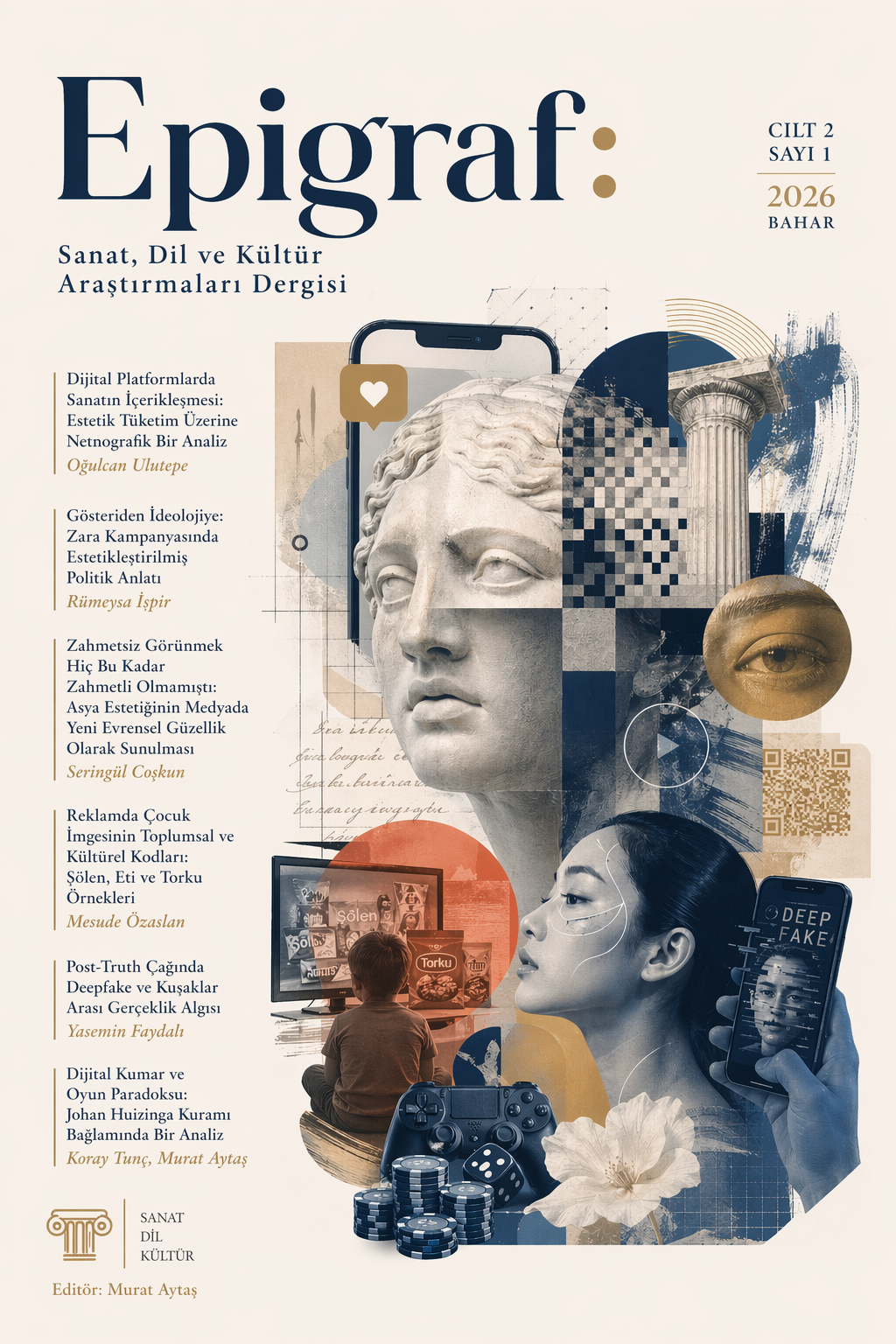
From Spectacle to Ideology: Aestheticized Political Narrative in Zara’s Campaign
Article Sidebar
Main Article Content
Abstract
This study examines the relationship between aesthetics and ideology in fashion advertising by analyzing Zara’s 2023 “Atelier” campaign within the framework of Ferdinand de Saussure’s semiotic approach. The research investigates how images evoking war, destruction, and death in the campaign visuals are reconstructed within an aesthetic narrative, thereby rendering their political meanings invisible. Accordingly, the study is grounded in a qualitative semiotic analysis of the concepts of signifier and signified. Within the scope of the analysis, three visuals from the campaign were examined in detail; visual codes, symbolic elements, and compositional arrangements were evaluated in relation to their ideological contexts. The findings reveal that although the campaign visuals are presented within an aesthetic unity, they implicitly refer to underlying realities of political violence and conflict. However, it was determined that through aestheticization, these visuals neutralize ideological content and reproduce political indifference. The study concludes that fashion advertising is not merely a field of aesthetic representation but also a medium through which ideological meanings are produced and cultural codes are circulated.
Article Details

This work is licensed under a Creative Commons Attribution 4.0 International License.
References
Aytaş, M., & Koca, S., & Ulutaş, S. (2023). Gerilimin zaman-imge bağlamında varoluşu: Her şeyi bitirmeyi düşünüyorum. Connectist: Istanbul University Journal of Communication Sciences, (64), 71–98.
Aytaş, M., & Demir, Y. (2024). Sergei Parajanov sineması ve kültürel ikonografi: Narın rengi (1969) filminin göstergebilimsel analizi. Tykhe Sanat ve Tasarım Dergisi, 9(16), 159–180.
Barut, E., & Odacıoğlu, M. C. (2017). Anlambilim teorilerindeki temel ve yan anlam kavramları ve anlambilim-çeviribilim ilişkisi. Tarih Okulu Dergisi, 11(33), 927–943. https://doi.org/10.14225/Joh1006
Bircan, U. (2015). Saussure’de dil, dilbilim ve göstergebilim. Sosyal Bilimler Araştırma Dergisi, (13), 43–66.
Civelek, M., & Türkay, O. (2020). Göstergebilimin kuramsal açıdan incelenmesine yönelik bir araştırma. Alanya Akademik Bakış Dergisi, 4(3), 771–787.
Çağlar, B. (2012). Bir iletişim biçimi olarak göstergebilim. LAÜ Sosyal Bilimler Dergisi, 3(2), 22–34.
Danış, E., Karataş, M., Güven, A., Nazlı, H., & Kahraman, H. (2023). Cereyan filminin göstergebilimsel çözümlemesi. Akademik Tarih ve Düşünce Dergisi, 10(5), 1655–1669.
Fiske, J. (2003). İletişim çalışmalarına giriş (S. İrvan, Çev.). Bilim ve Sanat Yayınları. (Orijinal eser 1982’de yayımlanmıştır)
Güneş, A. (2012). Çağdaş bir çözümleme yöntemi: Göstergebilim. E-Journal of New World Sciences Academy, 7(5), 32–43.
Güneş, A. (2013). Göstergebilim tarihi. NWSA Humanities, 8(4), 332–348.
Kanlıoğlu, A., & Aytaş, M. (2016). Sıradan objeleri yeniden yorumlamak: Chema Madoz fotoğraflarının eleştirel perspektiften göstergebilimsel analizi. Selçuk İletişim, 9(2), 225–241.
Özmakas, U. (2010). Peirce, Saussure ve Derrida’da gösterge kavramı (Yüksek lisans tezi, Hacettepe Üniversitesi).
Özgür, A. (2006). Göstergebilim. http://www.ahmetozgur.com/akademik/gostergebilim_2006.pdf
Saussure, F. de. (1971). Genel dilbilim dersi (Bally & Sechehaye, Ed.; Çev.).
Sivas, A. (2012). Göstergebilim ve sinema ilişkisi üzerine bir deneme. İstanbul Ticaret Üniversitesi Sosyal Bilimler Dergisi, 11(1), 527–538.
Ünal, M. F. (2016). Göstergebilimin serüveni. Mütefekkir Aksaray Üniversitesi İslami İlimler Fakültesi Dergisi, 3(6), 379–398.
Yakar Tapu, G. (2024). Yeşil aklama kapsamında yasaklanan reklam afişlerinin göstergebilimsel analizi. Online Journal of Art and Design, 12(3), 78–94.
Zara. (2023, Aralık 11). Atelier [Reklam fotoğrafı]. https://images.app.goo.gl/BSwdpTcQwcu67r459
Zara. (2023, Aralık 11). Atelier [Reklam fotoğrafı]. https://images.app.goo.gl/b7RsgweZ87xmzBxr8
Zara. (2023, Aralık 11). Atelier [Reklam fotoğrafı]. https://images.app.goo.gl/8jCKYg8NzyhT4BWaA
Zariç, M. (2014). Göstergebilim ve yapıbozumdan postmodernist yapısal eleştiriye. Turkish Studies, 9(12), 751–767.