
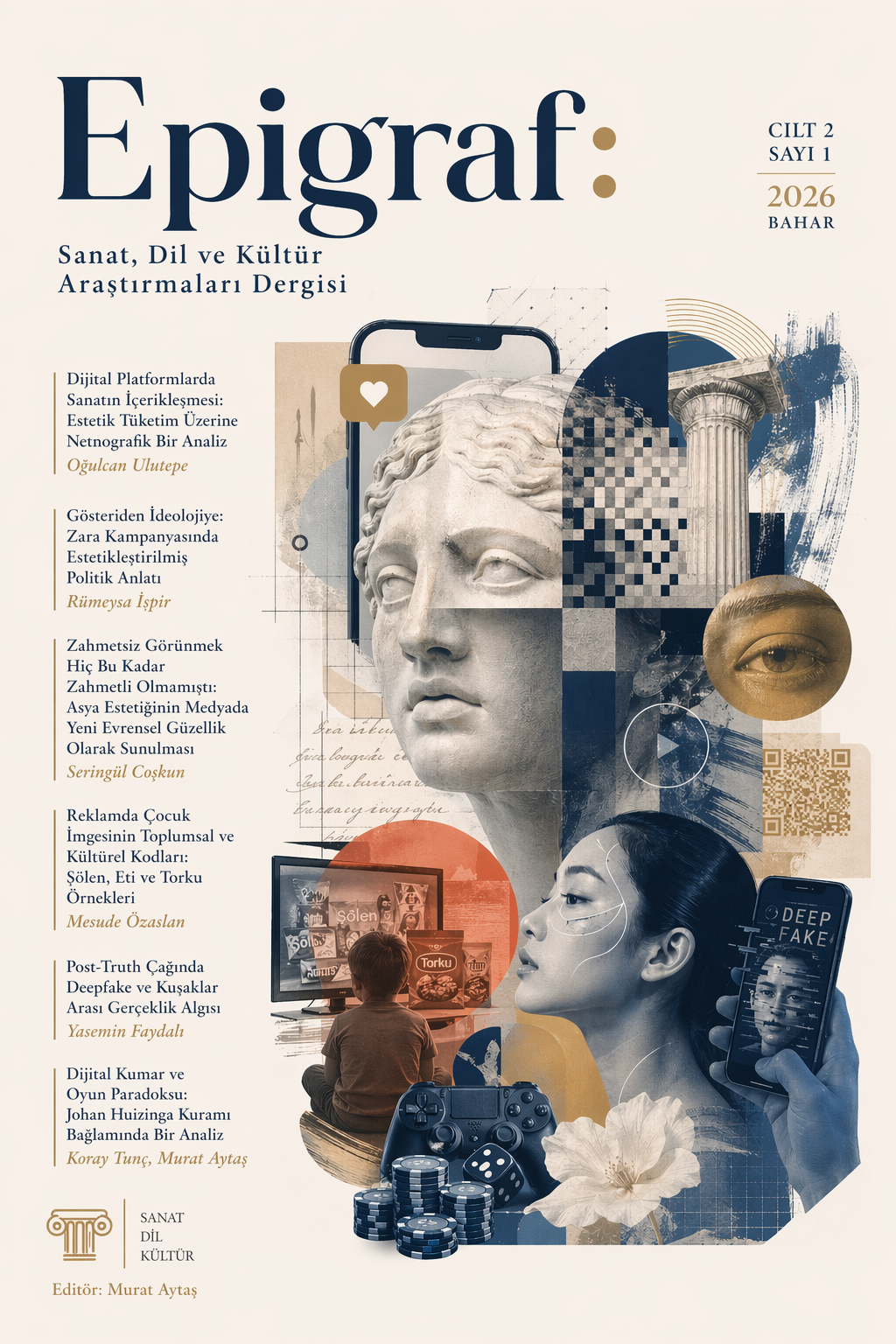
The Contentification of Art on Digital Platforms: A Netnographic Analysis of Aesthetic Consumption
Article Sidebar
Main Article Content
Abstract
This research aims to examine the ontological transformation and commercialization practices of artworks in the digital age through e-commerce and social media platforms. Shaped around Walter Benjamin’s concept of aura, Guy Debord’s spectacle, and Jean Baudrillard’s simulation theories, the study questions how high art is transformed into a pragmatic consumption object on digital platforms. Netnographic analysis, a qualitative research design, was used as the methodology; user interactions and archival data on platforms such as Trendyol, Temu, Instagram, X (Twitter), and Reddit were examined. In the analysis conducted over the works of iconic figures like Van Gogh and Frida Kahlo, it was determined that the functionality of the copy has replaced the uniqueness of the original artwork. The findings indicate two different tendencies in the relationship consumers establish with commodified art objects: on one hand, a pragmatic consumer profile that adopts the artwork as an ordinary commodity in pursuit of aesthetics and comfort; on the other hand, a critical consciousness that opposes the emptying of the artwork by tearing it from its context. Consequently, it is anticipated that while digitalization processes damage the aura of art and turn it into a spectacle decor, an ethical and aesthetic resistance against this commodification trend persists in certain segments of society.
Article Details

This work is licensed under a Creative Commons Attribution 4.0 International License.
References
Akyapı, N. (2022). Sosyal medya uygulamalarının pazar alanına dönüşümünün kitle kültürü bağlamında incelenmesi: Instagram’ın bu alandaki güvenilirliğinin analizi. Al-Farabi International Journal on Social Sciences, 7(2), 13–37.
Alavi, S., Ahuja, V., & Medury, Y. (2010). Building participation, reciprocity and trust: Netnography of an online community of Apple using regression analysis for prediction. Apeejay Business Review, 11(1–2), 82–96.
Arslan, C. (2018). Dijital yeniden üretim çağında sanat eseri: “Aura” kavramının dijital sanat bağlamında yeniden değerlendirilmesi. Art-Sanat Dergisi, 9, 405–414.
Aytaş, M. (2016). Ağ Toplumu ve Dijital Medyada Ontoloji, Zaman/Mekân Kavramlarını Yeniden Okumak. The Journal Of Academic Social Science, 37(37), 399-409.
Baudrillard, J. (2011). Simülakrlar ve simülasyon (O. Adanır, Çev.). Doğu Batı Yayınları.
Benjamin, W. (2015). Teknik olarak yeniden-üretilebilirlik çağında sanat yapıtı (G. Sarı, Çev.). Zeplin Kitap.
Costello, L., McDermott, M. L., & Wallace, R. (2017). Netnography: Range of practices, misperceptions, and missed opportunities. International Journal of Qualitative Methods, 16(1), 1–12. https://doi.org/10.1177/1609406917700647
Debord, G. (1996). Gösteri toplumu ve yorumlar (A. Ekmekçi & O. Taşkent, Çev.). Ayrıntı Yayınları.
Han, B. C. (2018). Güzeli kurtarmak: Güzeli yeniden düşünmek üzerine (K. Filiz, Çev.). İnsan Yayınları.
Horkheimer, M., & Adorno, T. W. (2014). Aydınlanmanın diyalektiği: Felsefi fragmanlar (N. Ülner & E. Öztarhan Karadoğan, Çev.). Kabalcı Yayıncılık.
Kozinets, R. V. (2002). The field behind the screen: Using netnography for marketing research in online communities. Journal of Marketing Research, 39(1), 61–72.
Manovich, L. (2017). Instagram and contemporary image. Cultural Analytics Lab.
Paklacı, B. (2014). Mike Featherstone postmodernizm ve tüketim kültürü üzerine bir inceleme (Yayımlanmamış yüksek lisans tezi). Trakya Üniversitesi, Sosyal Bilimler Enstitüsü.
Ritzer, G. (2000). Büyüsü bozulmuş dünyayı büyülemek: Tüketim araçlarının devrimcileştirilmesi (Ş. S. Kaya, Çev.). Ayrıntı Yayınları.